I
Recognize
Notice one visible drift — forward head, collapsed chest, screen reach, or chair-set hips.

A desk-side correction kit for bodies shaped by years of sitting.
Notice the drift. Make one small correction. Mark what changed. Return to work.
You write. You correct. You return.
The problem
Years of small positions — the forward head, the collapsed chest, the screen reach, the chair-set hips — became your default shape. No injury, no single day it went wrong. The body simply drifted, quietly, while you worked above the neck.
It is not a failure of will. It is what a body does when it holds the same shape, an hour at a time, for years.
The method
One small correction at a time, inside an ordinary workday.
I
Notice one visible drift — forward head, collapsed chest, screen reach, or chair-set hips.
II
Follow one short, two-minute correction for what you found.
III
Write one line in the ledger about what changed.
IV
Close the ledger and return to work, the body a little more present.
The First Errata Kit
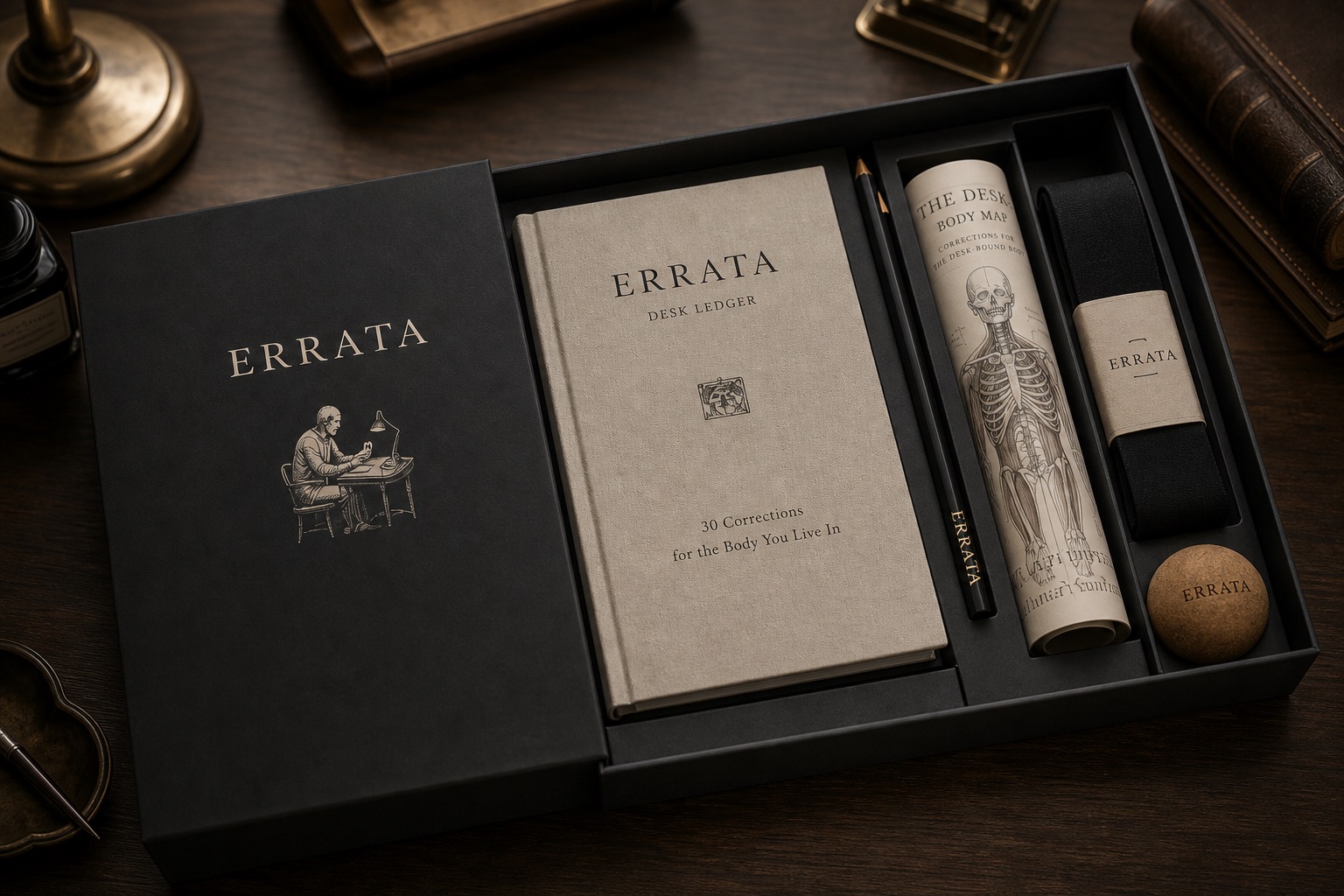
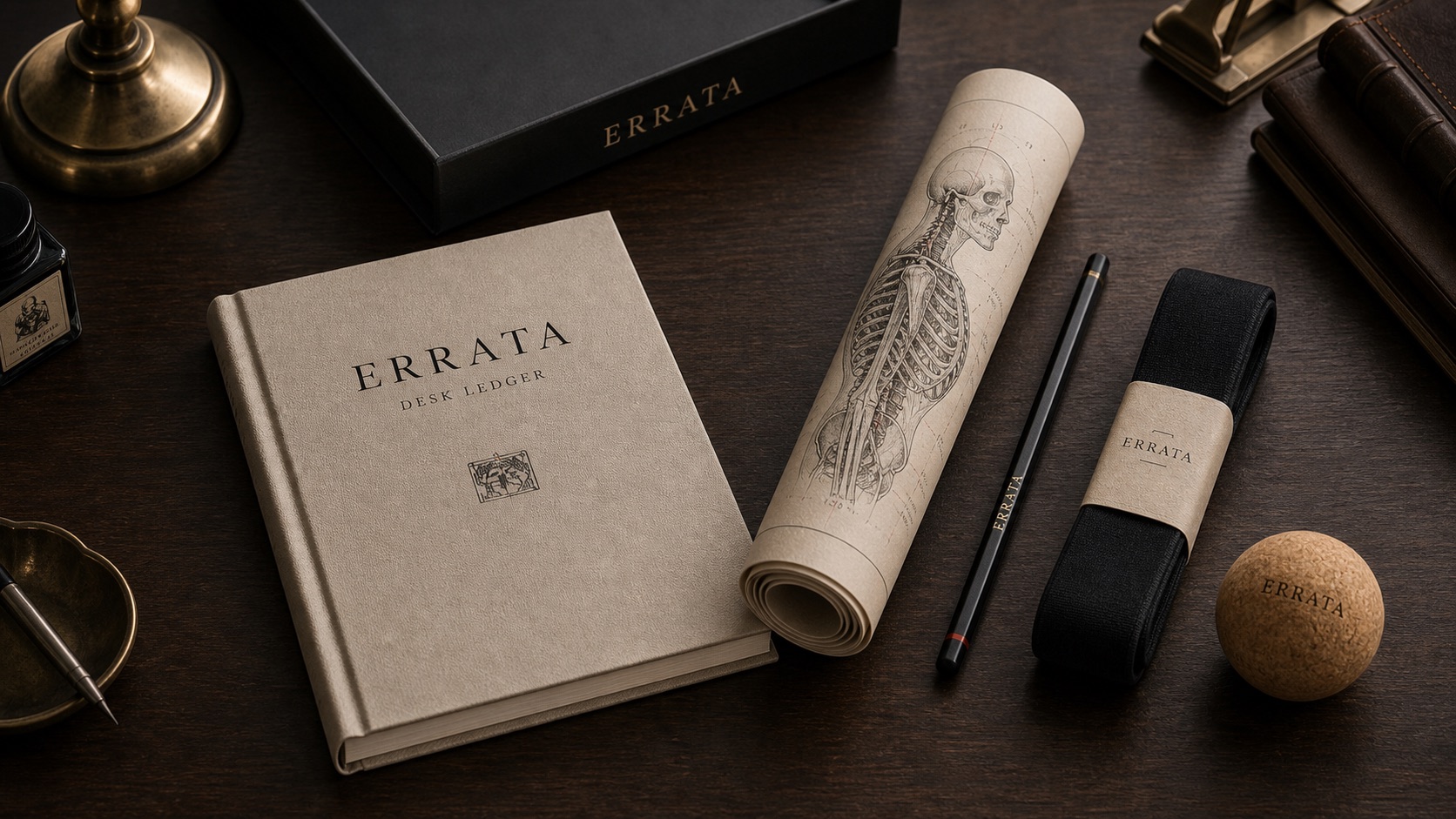
A bound book for the practice. An anatomical foldout for finding the drift. A few precise tools to lean on at the start — and to set down once the body remembers on its own.
First-batch price $79.99 / £59.99 · waitlist members are told first and priced first.
01
30 Corrections
A cloth-bound book with thirty numbered corrections. Recognize the drift, undo it, mark a line about what changed, and return to work. The filled ledger becomes the record of your practice.
02
A field guide to the usual errors
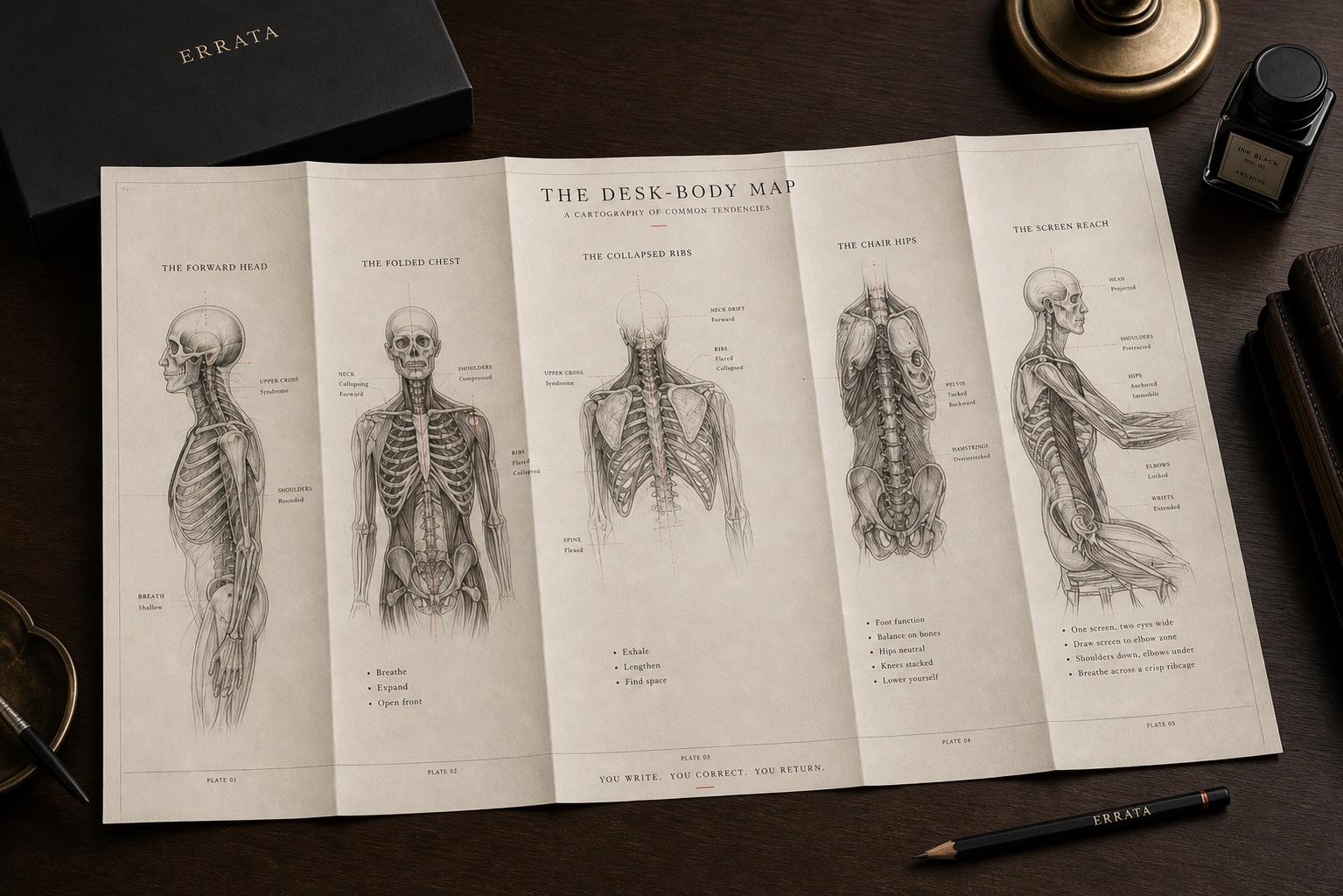
A large anatomical accordion foldout that maps the common desk drifts — forward head, folded chest, collapsed ribs, chair hips, screen reach — so you can find your own.
03
The pen, handed back
A single, well-made pencil: the author's instrument, for marking the ledger and taking the correction back into your own hand.
04
Support at the start
A simple band for the small corrective movements in the ledger — guidance while the motion is new. Not training equipment, and meant to be outgrown: once the body finds the range on its own, you set it down.
05
A cue, not a crutch
A compact cork ball for selected pressure and release — a way to find a spot until you can find it yourself. Not therapy; another support the practice is built to leave behind.
06
Where the practice lives
A black pressed case that keeps the ledger, map, pencil, band, and cork ball together on the desk, in reach. Premium from craft, not count.
The core · 01
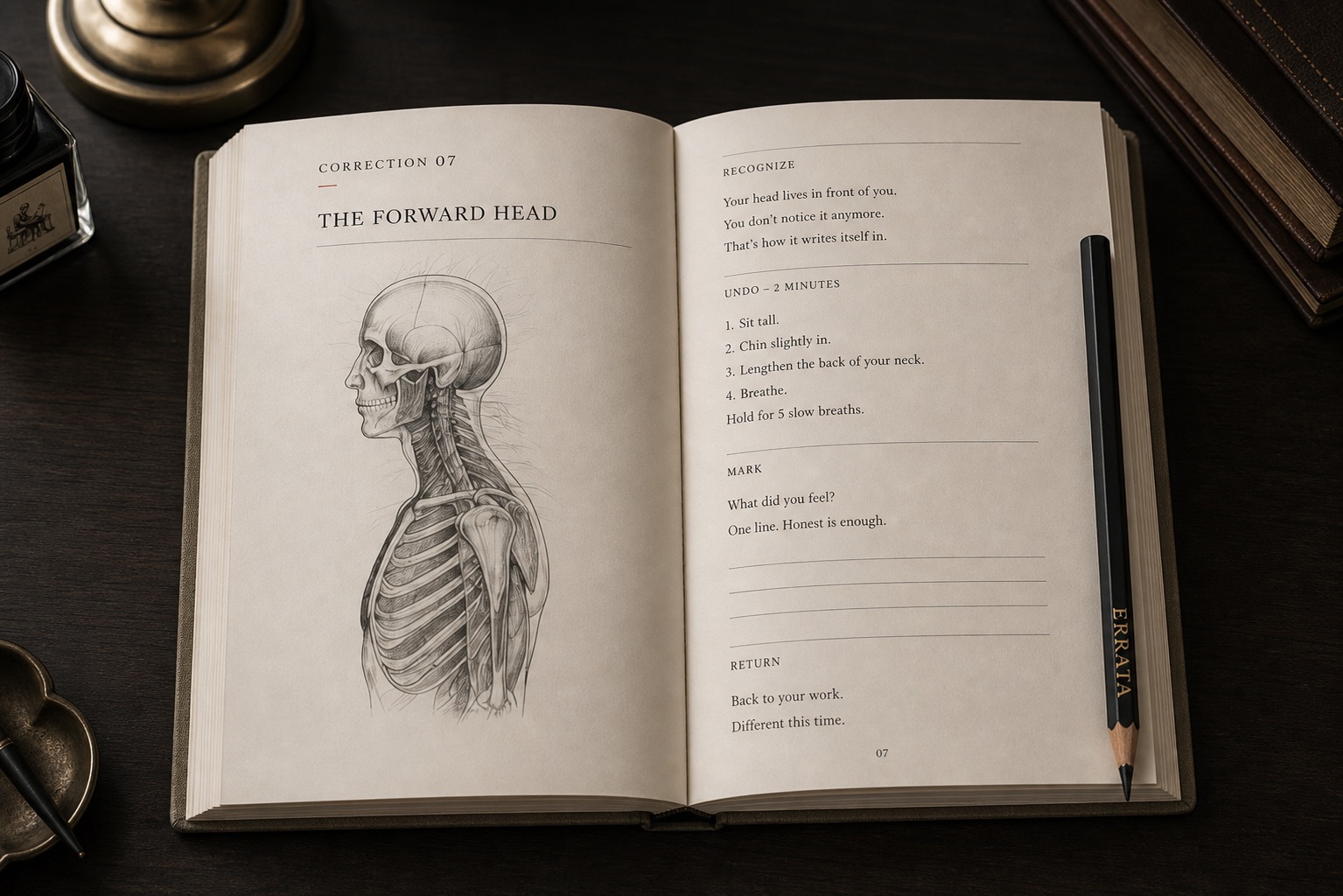
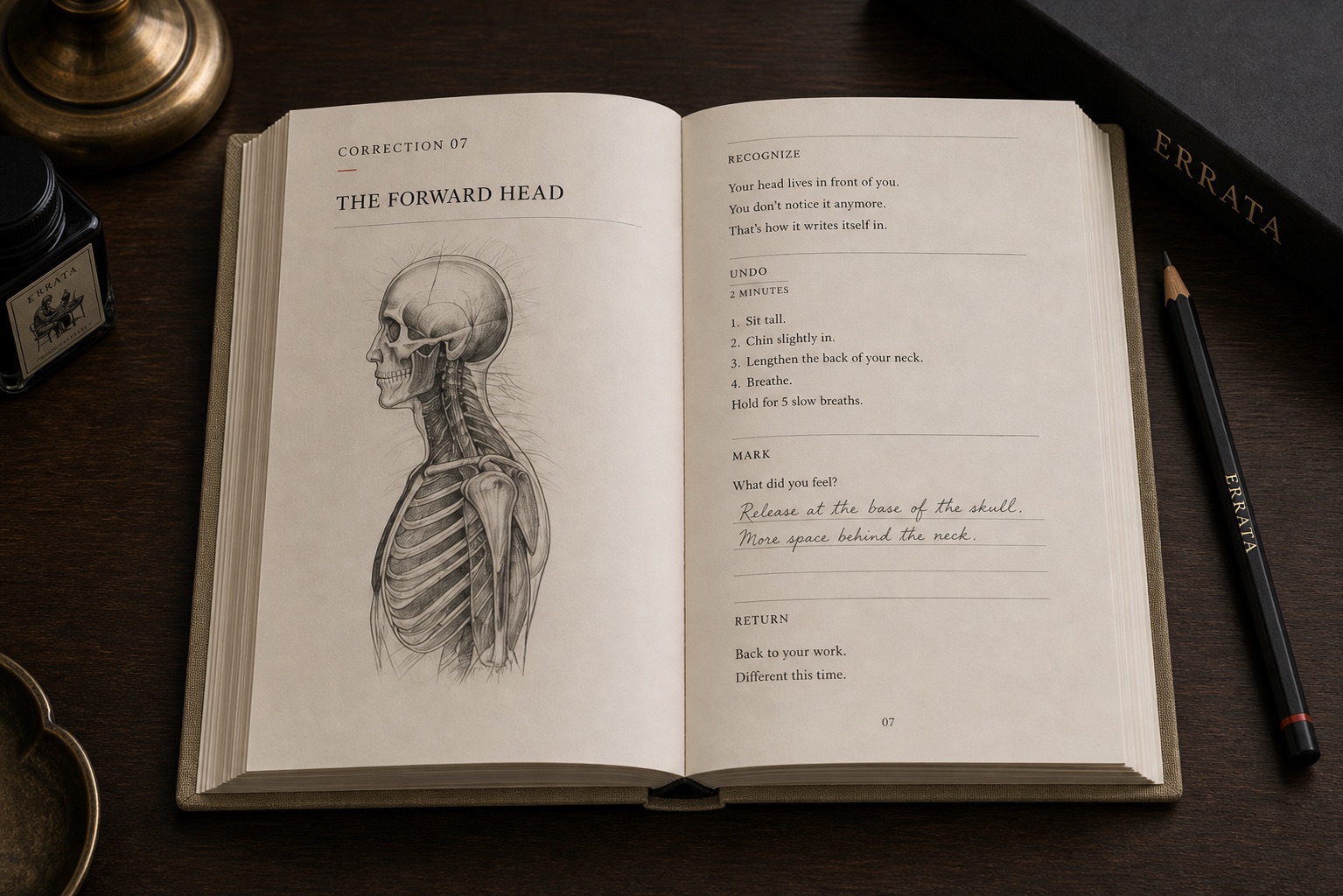
A cloth-bound book of thirty numbered corrections. Each page is built on the same four beats: Recognize the drift, Undo it with one short movement, Mark a single line about what changed, and Return to work. A graphite anatomical plate sits beside the page so you can see what you are correcting.
It is content, record, and keepsake at once. You read it, you write in it, and the filled book becomes the proof of the practice — thirty days of corrections in your own hand, not a score on a screen.
The core · 02
A large anatomical accordion foldout that names the common desk-bound errors — forward head, folded chest, collapsed ribs, chair-set hips, the reach toward the screen — drawn as classical graphite illustration on paper. It is a field guide for your own body.
Open it beside the ledger and find the drift that is yours today. The map tells you what to look for; the ledger gives you the correction. Together they are the whole of Errata — the other tools only help you act on what these two reveal.
Your first correction
What it is not
—Not fitness training.
—Not physical therapy.
—Not anti-aging.
—Not biohacking.
—Not posture shame.
—Not a dependence product.
Evidence and honesty
Prolonged sitting is consistently linked to recurring neck, shoulder, chest, hip, and lower-back discomfort, and short, regular movement breaks are among the few measures with reasonable evidence for easing it. That is the whole basis for Errata.
What we will not claim: Errata does not diagnose, treat, or cure anything. It does not promise to fix pain, reverse aging, or remake your body. It avoids unproven mechanisms — no "releasing fascia," no "realigning" promises. If something hurts, see a qualified clinician.
What it does, plainly: it gives desk workers a small, repeatable way to notice a postural drift, interrupt it for two minutes, and return to work — restoring an ordinary healthy range, not building a new one.
Waitlist
Errata is not out yet. The first batch is small and made to order. Join the first desk to be told before anyone else, hold the first-batch price of $79.99, and claim a kit before the public release.